The operating system for psychedelic care.
A.U.R.A. helps organizations run the regulated business, deliver the care, and continue the participant relationship long after the session — one connected platform for your team, and a persistent My AURA space for every participant.
- Run
- Deliver
- Grow
One platform. Both sides of the relationship.
Your organization gets a workspace to run operations and deliver care. Every participant gets their own My AURA. The two are connected where work is shared and separate where it stays personal.
A.U.R.A. Workspace
- Regulatory operations, center records, inventory and custody
- Scheduling, invoicing, payments and reporting
- Intake, sessions, integration and care workflows
- Builders for forms, tasks and courses
- Roles, permissions and audit history
My AURA
- Action Center with assigned forms and tasks
- Journal, with patterns and prompts drawn from their own writing
- Documents, library, invoices and account
- Courses and ongoing programs
- The same experience on web and native mobile
Run the business. Deliver the care. Grow the relationship.
Three dimensions of one system. Each screenshot below answers a question a visitor is already asking.
Run the regulated business.
A center operator opens A.U.R.A. and sees what needs attention today: authorizations coming due, inventory to reconcile, transfers and testing evidence to file, reports to run. Center records, locations, practitioner credentials, scheduling, invoicing and history sit behind it — one source of truth instead of a binder and four spreadsheets.
Center records stay distinct from a practitioner's clinical notes. Every change keeps its history.
What does running regulated operations actually look like?
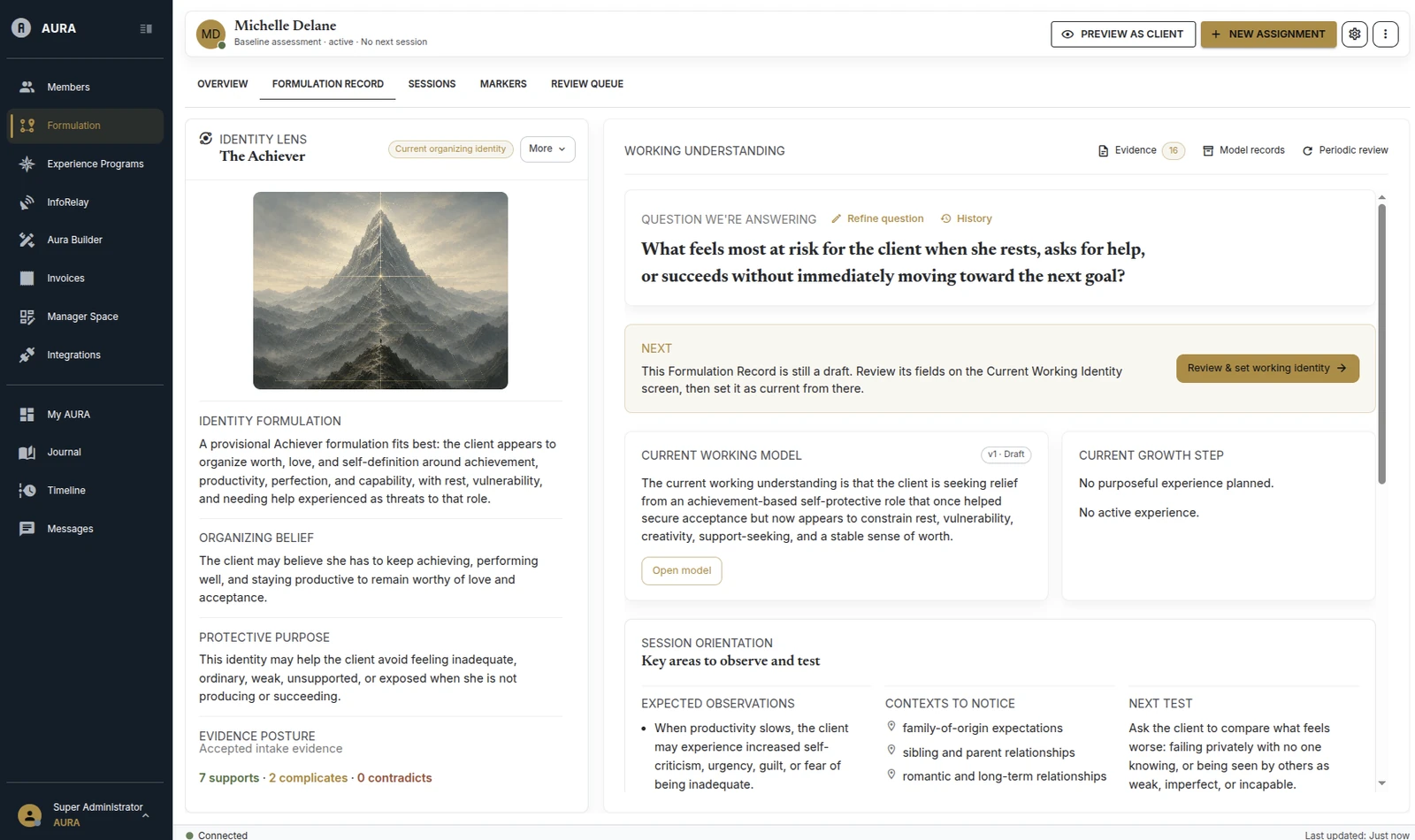
What does the participant's care look like from the practitioner's side?
Deliver the care.
From onboarding and screening through preparation, administration sessions and integration, the participant's work moves through one care workflow. Your team assigns forms, tasks, communication and courses; the participant completes them in their own space; documentation and the formulation record stay with the practitioner.
Nothing here is a fixed protocol — the workflow is yours to shape (see the builders below).
Continue the relationship.
Participants keep My AURA after treatment ends — journal, tasks, documents, courses and programs, on web and native mobile. Practitioners keep supporting them with integration programs, breathwork, meditation, reflective exercises, coursework and group programs.
Those programs can be included with treatment or offered later as paid programs — a second source of revenue for the practice, and a reason for the participant to stay.
How does ongoing engagement work?
Follow one participant through A.U.R.A.
The breadth of the platform, told as a single relationship rather than a module map.
- 01Participant
Books a first appointment
Today, through the practitioner.Self-booking · In development
- Organization
The appointment lands in A.U.R.A.
And in the team's Google or Outlook calendar. Scheduling, records and billing start from the same entry.
02 - 03Participant
Enters My AURA
Intake, screening and consent forms are waiting in the Action Center — on web or the mobile app.
- Organization
Preparation and requirements are tracked
Preparation work, practitioner credential context and regulatory prerequisites are visible and completed before the session.
04 - Organization
The session is delivered and documented
The provider documents care. The center records administration, inventory custody and its regulatory obligations — in the center's own records.
05 - 06Participant
Integration begins
Journal prompts, tasks and learning arrive in My AURA. Their reflection stays on their side of the boundary.
- Organization
The practitioner enrolls them in a program
An integration course, a breathwork series, a group cohort — included with treatment or offered as a paid program.
07 - 08Participant
Months later, still here
Still journaling, still learning, and able to purchase the next program without leaving the ecosystem.
Built to be built on.
A.U.R.A. does not force one psychedelic-care workflow. Your team designs the participant experience with three builders, and the platform delivers it to each participant's My AURA.
How customizable is the platform? Each builder is shown in its own editing view, not a finished artifact.
Form Builder
Intake, assessments, surveys, worksheets, signatures and questionnaires — structured data collected in the participant's own space.
Task Builder
Reflection exercises, journal prompts, uploads, quizzes, checklists and custom actions, assigned individually or as part of care.
Course Builder
Modules, lessons, media, tasks and progression — structured learning participants continue in My Learning.
Programs. Combine forms, tasks, courses, live activities and communications into one guided participant experience. The framework exists today; the composition workspace is being finished with founding organizations.
Fewer systems to pay for, maintain and reconcile.
These functions usually live in separate tools with separate logins, separate records of the same person and separate invoices. In A.U.R.A. they share one record, one calendar and one participant relationship.
- Scheduling
- Forms
- Client records
- Tasks
- Courses
- Documents
- Invoicing & payments
- Journaling
- Communications
- Compliance tracking
- Inventory
- Reporting
Scheduling lives inside the record
An integrated calendar that connects to Google and Outlook, so appointments, sessions and program dates share one source.
Built for the way your organization works.
Same platform. Different parts of it carry the weight.
Operate the regulated center, not just document the sessions.
Center records stay distinct from practitioner clinical records. Inventory, custody, transfers, testing evidence and waste are tracked with their history. Authorizations, locations and practitioner qualification context sit behind the attention queue, and reporting draws from the same source.
- Regulatory operations and attention management
- Regulated inventory, custody and transfer workflows
- Multiple facilitators, roles and permissions across the center
- Reporting infrastructure and audit history
The center view: what needs attention today, with the records behind it.
Why organizations pay for A.U.R.A.
Not because it is another practice-management tool. Because several things work together.
No revenue share. You keep what you earn.
A.U.R.A. does not take a percentage simply because your organization succeeds.
See pricingA deeper operating system for regulated care
Center records, inventory custody, authorizations and reporting infrastructure — not a documentation layer with a compliance checkbox.
A participant ecosystem people return to
My AURA is designed to be useful throughout and after care — not a portal opened once for paperwork.
Ongoing services you can offer
Integration programs, courses and group work — included with treatment or sold later — extend the relationship and the practice's revenue.
Several tools become one environment
One record, one calendar, one participant relationship — and fewer subscriptions, integrations and reconciliations to maintain.
Privacy by Design
Two-lens architecture separates personal and organizational data.
Role-Based Access
Owners, practitioners, and participants each see only their part of the work.
Adaptable & Modular
Start with what you need. Add what you want. Scale at your pace.
Built for This Work
Purpose-built for psychedelic centers, retreat and integration organizations, and transformational programs.
Help shape what comes next.
We're partnering with a small group of psychedelic centers, retreat, integration and transformational organizations to shape A.U.R.A. around how this work actually happens.